 UPCOMING QCO ON TEXTILE GOODS BY MINISTRY OF TEXTILE



BIS ISI Certification For Steel Products
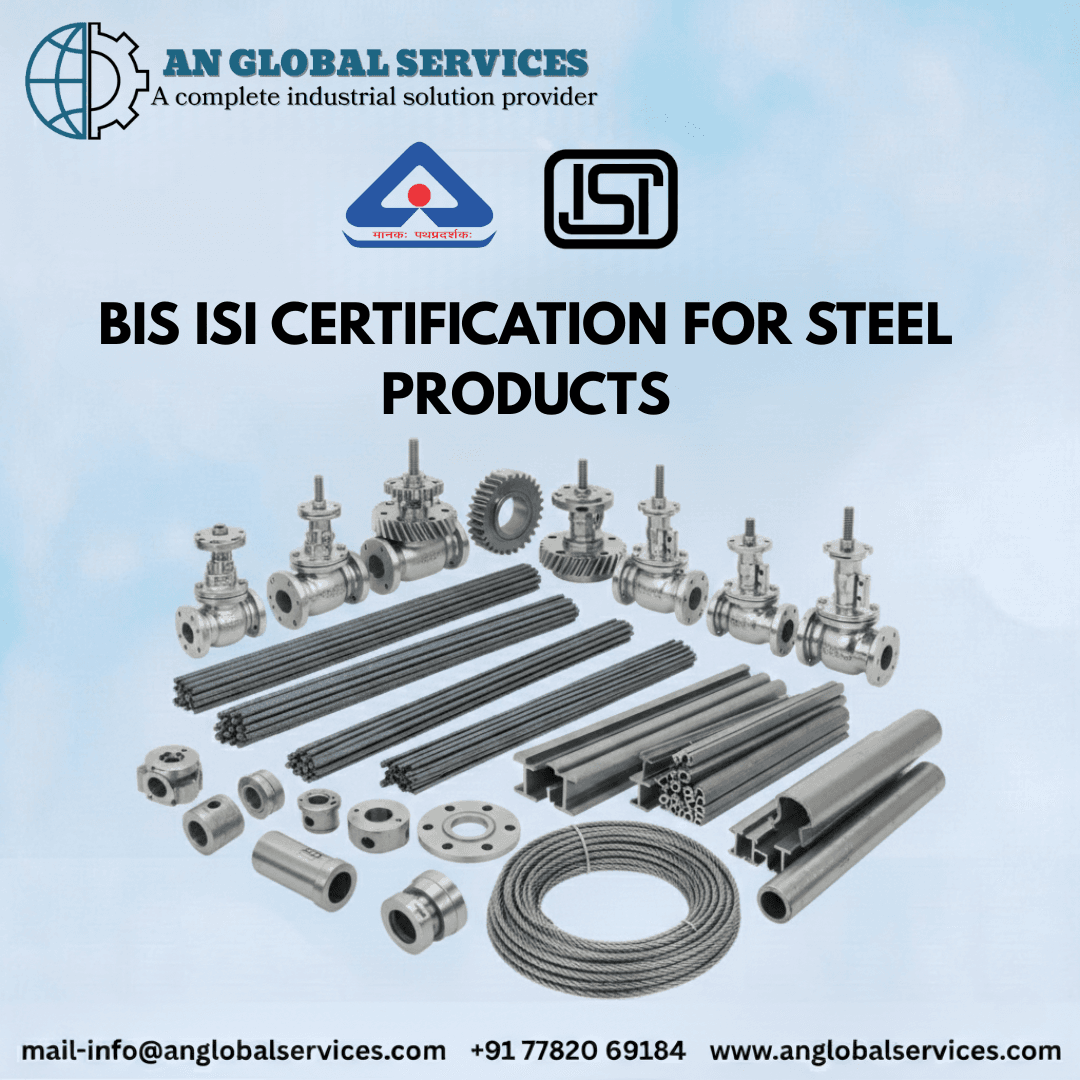
BIS CERTIFICATION FOR STEEL
BIS (ISI) Certification for Steel Products is a mandatory quality certification issued by the Bureau of Indian Standards (BIS). This certification ensures that steel products manufactured or imported into India conform to the applicable Indian Standards (IS) related to quality, safety, strength, and performance.
Steel products play a critical role in infrastructure, construction, manufacturing, and engineering sectors. Therefore, BIS mandates ISI Certification for selected steel products to safeguard public safety, improve product reliability, and prevent the circulation of sub-standard materials in the Indian market. Manufacturers must obtain BIS ISI Certification before selling or distributing notified steel products in India.
BIS (ISI) Certification for steel products is not only a legal requirement but also a mark of quality, safety, and trust. It helps manufacturers gain credibility, expand market access, and comply with Indian regulatory standards. With proper documentation, testing facilities, and expert guidance, the certification process can be completed smoothly and efficiently.
Benefits of BIS Certification for Steel Products
BIS certification for steel products under the ISI Mark Scheme is a mandatory regulatory requirement in India for several iron and steel materials notified by the Bureau of Indian Standards. Steel products used in construction, infrastructure, engineering, and manufacturing must comply with applicable Indian Standards to ensure safety, strength, and durability. Beyond regulatory compliance, BIS certification provides significant commercial, quality, and market advantages to manufacturers and importers.
1. Mandatory Legal Compliance and Market Authorization
BIS certification authorizes manufacturers and importers to legally manufacture, sell, and distribute notified steel products in India. Steel items such as TMT bars, structural steel, pipes, and sheets cannot be marketed without a valid ISI Mark. Compliance helps avoid penalties, product bans, seizure, and rejection at customs or project sites.
2. Assured Strength, Safety, and Quality
BIS-certified steel products are tested in BIS-recognized laboratories for chemical composition, mechanical strength, ductility, and performance parameters as per Indian Standards. Certification ensures consistent quality, structural safety, and long-term durability in construction, industrial, and infrastructure applications.
3. Increased Trust Among Builders and Engineers
Builders, contractors, engineers, and government authorities strongly prefer BIS-certified steel due to guaranteed compliance with national safety norms. The ISI Mark acts as proof of authenticity and quality, helping eliminate substandard or counterfeit steel products from critical construction and infrastructure projects.
4. Competitive Advantage in Government and Infrastructure Projects
Many government tenders, public sector projects, and large infrastructure developments mandate BIS certification for steel products. ISI-marked steel gains preference in public procurement, real estate development, EPC contracts, and large-scale industrial projects.
5. Reduced Legal, Financial, and Reputational Risk
BIS certification minimizes the risk of structural failures, disputes, recalls, and legal liabilities arising from poor-quality steel. Compliance with Indian Standards demonstrates due diligence and strengthens brand credibility during inspections, audits, and quality assessments by regulatory authorities.
Documents Required for BIS (ISI) Certification for Steel Products
To obtain BIS (ISI) Certification for steel products, manufacturers must submit the following documents to demonstrate compliance with applicable Indian Standards and quality requirements:
- Company Incorporation Documents: Certificate of Incorporation or Business Registration proof.
- Factory Address Proof & Layout Plan: Details of manufacturing area, testing laboratory, and storage facilities.
- Manufacturing Process Flow Chart: Step-by-step process from raw material procurement to finished product.
- List of Manufacturing Machinery & Equipment: Details of machines used for steel production and processing.
- In-house Laboratory Details: List of testing equipment as prescribed in the relevant Indian Standard.
- Quality Control Manual & Test Records: Procedures followed for routine quality checks and inspections.
- Raw Material Test Certificates: Chemical and mechanical test reports of raw materials.
- Product Test Report: Issued by a BIS-recognized or BIS-approved laboratory.
- Authorization Letter from Manufacturer: Required if the application is filed through a consultant or representative.
- Trademark Registration Certificate: Or authorization letter to use the brand name, if applicable.
Process Of BIS Certification For Steel Products
As per the Quality Control Orders (QCOs) issued by the Government of India and implemented by the Bureau of Indian Standards (BIS), several steel products have been brought under mandatory BIS (ISI) certification. Manufacturers must first identify the applicable Indian Standard (IS) relevant to their specific steel product category. Once the applicable Indian Standard is identified, the manufacturer must carefully study the standard and ensure that the steel product fully complies with the prescribed quality, safety, chemical, and mechanical requirements. Additionally, the manufacturing unit must be equipped with the required production machinery and in-house testing facilities as specified in the relevant Indian Standard.
- Step 1: Preparation of documentation prior to submission of the application for BIS (ISI) Certification for steel products.
- Step 2: Submission of the BIS application along with the requisite documents through the BIS Manakonline portal.
- Step 3: Scrutiny of the application and documents by BIS officials for compliance with applicable Indian Standards.
- Step 4: Nomination of BIS auditor for inspection of the manufacturing unit.
- Step 5: Inspection and audit of the steel manufacturing premises, machinery, and in-house testing facilities by the BIS auditor.
- Step 6: Drawing of product samples during factory inspection for independent testing.
- Step 7: Testing of drawn samples in a BIS-recognized or BIS-approved laboratory as per the relevant Indian Standard.
- Step 8: Grant of BIS (ISI) Certification license to the steel product manufacturer upon successful compliance.
STEEL PRODUCTS UNDER BIS CRS / ISI CERTIFICATION SERVICE
| Product | Standard | Product | Standard |
|---|---|---|---|
| Steel Tubes, Tubulars and Other Wrought Steel Fittings – Part 1 | IS 1239 (Part 1): 2014 | Hot Rolled Steel Plates | IS 2062: 2011 |
| Steel Pipes for Water Supply | IS 3589: 2001 | Structural Steel Sections | IS 2062: 2011 |
| Cold Rolled Steel Sheets | IS 513: 2016 | Galvanized Steel Sheets | IS 277: 2018 |
IS 1239 (Part 1): 2014
IS 2062: 2011
IS 3589: 2001
IS 2062: 2011
IS 513: 2016
IS 277: 2018

