 UPCOMING QCO ON TEXTILE GOODS BY MINISTRY OF TEXTILE


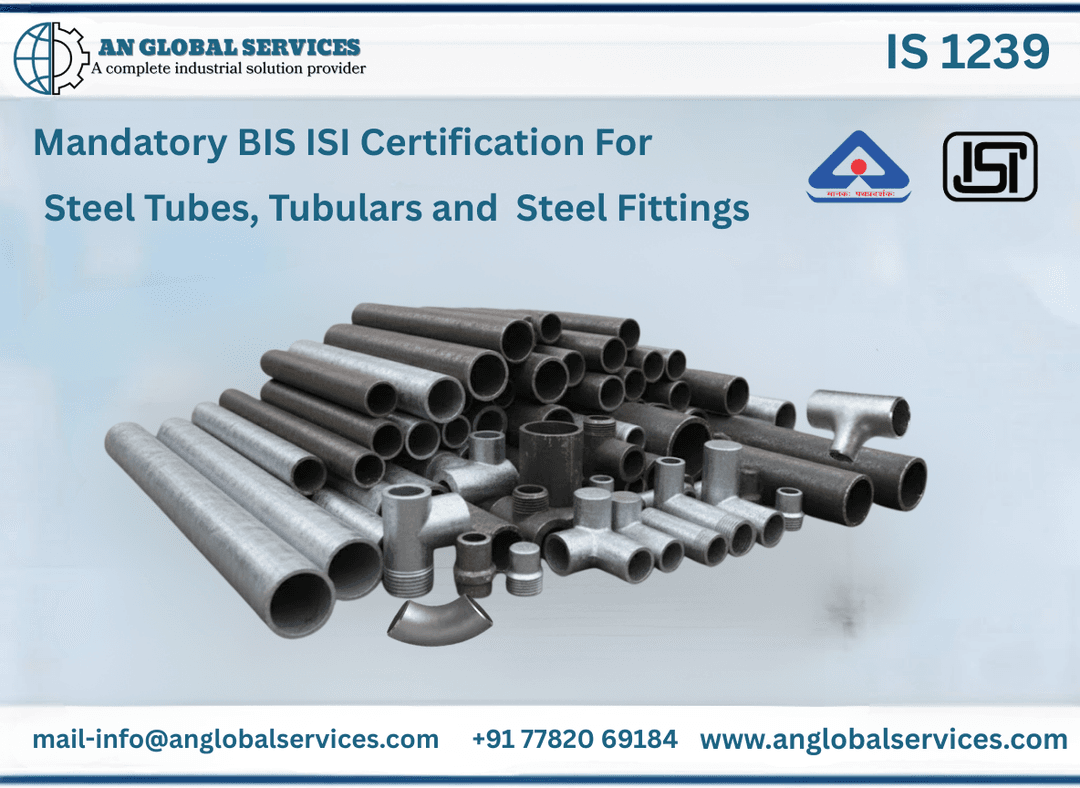
BIS ISI Certification for Steel Tubes – IS 1239 (Part 1)
BIS ISI certification is mandatory for steel tubes, tubulars, and other wrought steel fittings classified under Part 1: Steel Tubes as per Indian Standard IS 1239 (Part 1):2014. These steel tubes are widely used in construction, infrastructure, manufacturing, energy, automotive, and mechanical engineering applications where strength, reliability, and dimensional accuracy are critical.
Steel tubes covered under IS 1239 (Part 1):2014 are used for structural frameworks, fluid transportation, scaffolding, pipelines, machinery, and general engineering purposes. The standard specifies essential technical requirements related to chemical composition, mechanical properties, dimensions, and tolerances to ensure consistent quality and safe performance.
BIS ISI Mark certification under IS 1239 (Part 1) ensures regulatory compliance under the latest Quality Control Order (QCO), enhances acceptance in government and industrial projects, and builds trust among engineers, contractors, and procurement authorities.
IS 1239 (Part 1):2014 – Key Quality & Performance Requirements for Steel Tubes
- (i) Manufacture of steel tubes from suitable quality wrought steel
- (ii) Compliance with specified chemical composition limits to ensure strength and durability
- (iii) Mechanical property requirements including tensile strength and elongation
- (iv) Dimensional accuracy, wall thickness, and length tolerances
- (v) Surface finish free from harmful defects affecting performance
- (vi) Testing for flattening, bending, and other mechanical properties
- (vii) Suitability for structural, fluid conveyance, and engineering applications
- (viii) Mandatory ISI marking, traceability, and batch identification
Overview of ISI Mark Certification for Steel Tubes (IS 1239 Part 1)
IS 1239 (Part 1):2014 applies to steel tubes intended for use in structural works, pipelines, mechanical systems, scaffolding, and general engineering applications. These tubes are designed to withstand mechanical loads, environmental conditions, and operational stresses encountered in industrial and construction environments.
As per the Quality Control Order issued by the Ministry of Steel on 5 February 2024, compliance with IS 1239 (Part 1):2014 is mandatory. Manufacturers must obtain BIS ISI certification under the Product Certification Scheme (ISI Mark Scheme – Scheme I, Schedule II) before manufacturing, selling, or importing steel tubes in India.
BIS ISI certification is granted only after successful product testing, factory inspection, and verification of quality control systems. Certified steel tubes are permitted to bear the ISI Mark, confirming conformity to Indian Standards and ensuring safe, reliable, and consistent performance across demanding applications.
Process Required for BIS ISI Mark Certification for Steel Tubes (IS 1239 Part 1:2014)
To obtain the BIS ISI Mark for steel tubes, tubulars, and other wrought steel fittings under Indian Standard IS 1239 (Part 1):2014, manufacturers must comply with the BIS Product Certification Scheme (ISI Mark Scheme – Scheme I, Schedule II). This certification ensures that steel tubes meet mandatory requirements related to chemical composition, mechanical properties, dimensional accuracy, and performance before being manufactured, sold, or imported into the Indian market.
Estimated Timeline: The BIS ISI certification process for steel tubes generally takes around 30–45 days for Indian manufacturers and up to 180 days for foreign manufacturers, depending on factory preparedness, inspection scheduling, and laboratory testing requirements.
Step-by-Step Certification Process
- Application Submission: Submit the BIS application through the Manak Online portal by providing steel tube details, applicable Indian Standard (IS 1239 Part 1:2014), factory address, manufacturing process, machinery, and product range.
- Testing Readiness: Ensure availability of testing facilities for chemical composition analysis, tensile strength, elongation, flattening test, bending test, and dimensional verification as prescribed under IS 1239 (Part 1):2014.
- Factory Inspection: A BIS officer conducts an on-site inspection to verify raw material controls, manufacturing facilities, testing equipment, quality control systems, and compliance with the Scheme of Inspection and Testing (SIT).
- Sample Drawing and Testing: Steel tube samples are drawn during inspection and tested in BIS-recognized laboratories as per IS 1239 (Part 1):2014 requirements.
- Grant of BIS License: Upon successful inspection and satisfactory test results, BIS grants the Certification Marks License (CM/L), authorizing the use of the ISI Mark on steel tubes.
Requirements to Obtain BIS License for Steel Tubes (IS 1239 Part 1)
- Compliance of steel tubes with chemical, mechanical, dimensional, and performance requirements specified under IS 1239 (Part 1):2014.
- Use of suitable quality wrought steel conforming to applicable Indian Standards.
- Availability of testing facilities for chemical analysis, tensile strength, elongation, flattening, bending, and dimensional checks.
- Appointment of qualified quality control personnel to ensure consistent conformity to IS 1239 requirements.
- Strict adherence to the Scheme of Inspection and Testing (SIT) and BIS ISI certification guidelines applicable to steel tubes.
To obtain BIS ISI certification for steel tubes under Product Certification Scheme-I, manufacturers are required to submit documents broadly classified into the following categories:
- Administrative Details: Business registration documents, factory address proof, GST registration, and statutory approvals.
- Technical Details: Steel tube specifications, dimensions, wall thickness, grade, manufacturing process, and test parameters as per IS 1239 (Part 1):2014.
- Quality Control Personnel Details: Qualifications, experience, and responsibilities of personnel managing quality assurance and testing.
- Commercial Details: Brand name, trademark ownership (if applicable), and authorization documents.
Cost of BIS ISI Certification for Steel Tubes (IS 1239 Part 1)
The following are indicative government and related charges involved in obtaining BIS ISI certification for steel tubes under Product Certification Scheme-I. All statutory fees are payable directly to the Bureau of Indian Standards (BIS).
| S. No. | Particular | Amount (INR) | Remarks |
|---|---|---|---|
| 1 | Application Fee | ₹1,000 | Payable to BIS |
| 2 | Inspection / Audit Fee | ₹7,000 | Payable to BIS |
| 3 | Product Testing Fee | As applicable | Depends on tube size & laboratory |
| 4 | Marking Fee | As per actual | Based on BIS fee structure |
Important Note: Product testing as per IS 1239 (Part 1):2014 is a critical stage in the BIS ISI certification process. BIS may conduct a factory pre-assessment to evaluate manufacturing and quality control readiness. Charges may vary depending on tube size, grade, and testing scope.
Benefits of Getting ISI Mark Certification for Steel Tubes (IS 1239 Part 1:2014)
Obtaining the ISI Mark for steel tubes under Indian Standard IS 1239 (Part 1):2014 offers important legal, commercial, and quality advantages. ISI certification confirms that steel tubes comply with prescribed Indian standards for chemical composition, mechanical strength, dimensional accuracy, and performance, making them legally approved for use in construction, infrastructure, and industrial applications across India.
1. Mandatory Legal Compliance
Steel tubes covered under IS 1239 (Part 1):2014 are notified products under the Quality Control Order issued by the Ministry of Steel. ISI Mark certification is mandatory for lawful manufacturing, sale, or import of steel tubes in India.
2. Acceptance in Infrastructure & Industrial Projects
ISI-certified steel tubes are widely accepted in construction projects, infrastructure works, pipelines, scaffolding systems, and industrial installations. Certification simplifies approvals in government tenders and technical evaluations.
3. Assured Mechanical Strength & Reliability
Certified steel tubes are tested for tensile strength, elongation, flattening, bending, and dimensional accuracy, ensuring consistent performance under structural and mechanical loads.
4. Enhanced Brand Credibility & Market Trust
The ISI Mark enhances trust among engineers, contractors, consultants, and procurement authorities. Certified steel tubes are recognized as compliant with national quality and safety benchmarks.
5. Competitive Advantage & Business Expansion
ISI-certified steel tubes gain preference in large-scale infrastructure projects, EPC contracts, and government tenders, helping manufacturers expand into regulated and high-value markets.
Frequently Asked Questions (FAQs) – BIS ISI Certification for Steel Tubes (IS 1239 Part 1:2014)
1. Is BIS ISI certification mandatory for steel tubes in India?
Yes. Steel tubes covered under IS 1239 (Part 1):2014 must comply with BIS requirements. ISI Mark certification is mandatory as per the Quality Control Order issued by the Ministry of Steel.
2. Which Indian Standard applies to steel tubes?
Steel tubes, tubulars, and other wrought steel fittings (Part 1: Steel Tubes) are governed by Indian Standard IS 1239 (Part 1):2014.
3. What are the common applications of IS 1239 steel tubes?
IS 1239 steel tubes are used in construction frameworks, scaffolding, pipelines, structural supports, machinery, and general engineering applications across multiple industries.
5. What tests are conducted under IS 1239 (Part 1):2014?
Testing includes chemical composition analysis, tensile strength and elongation tests, flattening and bending tests, dimensional checks, and visual inspection as specified under the standard.
6. What happens if non-ISI certified steel tubes are supplied?
Supplying non-ISI certified steel tubes may result in penalties, product seizure, rejection in government and infrastructure projects, and legal action under the Bureau of Indian Standards Act, 2016.

