 UPCOMING QCO ON TEXTILE GOODS BY MINISTRY OF TEXTILE


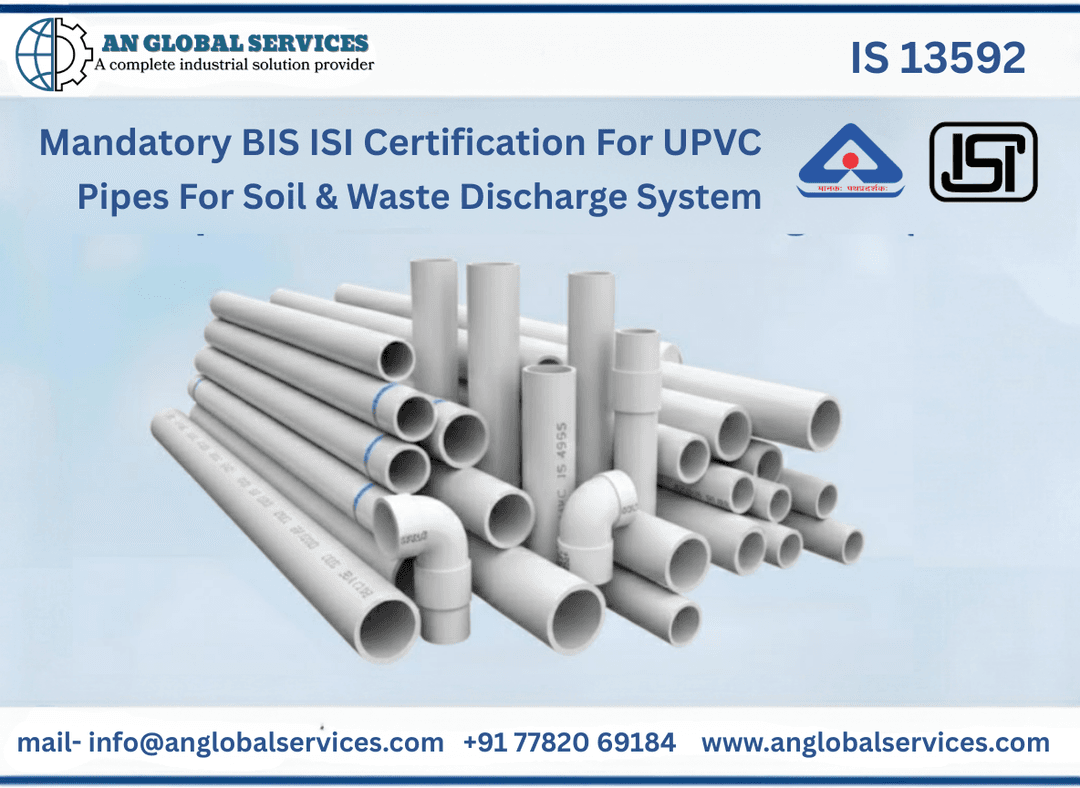
BIS ISI Certification for UPVC Pipes for Soil & Waste Discharge Systems – IS 13592
BIS ISI certification is mandatory for unplasticized Polyvinyl Chloride (PVC-U) pipes used for soil and waste discharge systems inside and outside buildings as per Indian Standard IS 13592:2013. These pipes are used for soil discharge, waste water, ventilation, rainwater, and rainwater harvesting applications. Manufacturers must comply with the applicable Indian Standard to legally manufacture and supply these products in India.
IS 13592:2013 was adopted by the Bureau of Indian Standards after approval by the Civil Engineering Division Council and finalization by the Plastic Piping Systems Sectional Committee. The standard defines technical requirements for the manufacture and selection of PVC-U pipes intended for building drainage, soil, and waste discharge systems.
BIS ISI Mark certification ensures compliance with statutory regulations, enhances acceptance in residential, commercial, and infrastructure projects, and builds trust among architects, plumbers, builders, and regulatory authorities.
IS 13592:2013 – Key Quality & Performance Requirements for UPVC Pipes for Soil & Waste Discharge Systems
- (i) Use of unplasticized polyvinyl chloride (PVC-U) as base material
- (ii) Nominal outside diameters ranging from 40 mm to 315 mm
- (iii) Plain-ended or socket-ended pipes for solvent cement jointing
- (iv) Classification of pipes as Type A (ventilation & rainwater) and Type B (soil & waste discharge)
- (v) PVC resin composition with K-value of 64 or higher as per IS 4669
- (vi) Vicat softening temperature, stress relief, and reversion performance requirements
- (vii) Resistance to sulphuric acid and external blows at 0°C
- (viii) Mandatory marking, labeling, traceability, and batch identification
Overview of ISI Mark Certification for UPVC Soil & Waste Discharge Pipes (IS 13592)
IS 13592:2013 covers unplasticized PVC-U pipes used for soil and waste discharge systems inside and outside buildings, including ventilation, rainwater drainage, and rainwater harvesting systems. The standard applies to gravity flow applications and does not cover pressurized water supply pipes.
The standard specifies requirements for pipes with nominal outside diameters of 40, 50, 63, 75, 90, 110, 125, 140, 160, 180, 200, 250, and 315 mm. Pipes may be plain-ended or socket-ended and must demonstrate adequate mechanical strength, durability, and joint integrity.
The pipe material shall primarily consist of PVC resin with approved additives only. Pipes must successfully pass dimensional checks, visual appearance, reversion, stress relief, Vicat softening temperature, chemical resistance, impact resistance, and water tightness tests. Products are approved for ISI marking only after passing prescribed type, acceptance, and routine tests under BIS supervision.
Process Required for BIS ISI Mark Certification for UPVC Pipes for Soil & Waste Discharge Systems (IS 13592:2013)
To obtain the BIS ISI Mark for unplasticized Polyvinyl Chloride (PVC-U) pipes used in soil and waste discharge systems under Indian Standard IS 13592:2013, manufacturers must comply with the BIS Product Certification Scheme (Scheme I). This certification ensures that PVC-U pipes meet mandatory requirements related to material composition, dimensional accuracy, mechanical strength, and durability before being manufactured or supplied in the Indian market.
Estimated Timeline: The BIS ISI certification process for UPVC soil and waste discharge pipes generally takes around 30 days for Indian manufacturers and up to 180 days for foreign manufacturers, depending on factory preparedness, inspection scheduling, and laboratory testing requirements.
Step-by-Step Certification Process
- Application Submission: Submit the BIS application through the Manak Online portal by providing PVC-U pipe details, applicable Indian Standard (IS 13592:2013), factory address, manufacturing process, and machinery information.
- Testing Readiness: Ensure availability of testing facilities as prescribed under IS 13592:2013, including dimensional checks, reversion test, stress relief test, Vicat softening temperature test, resistance to sulphuric acid, impact resistance, and water tightness of joints.
- Factory Inspection: A BIS officer conducts an on-site inspection to verify manufacturing infrastructure, raw material controls, in-house testing facilities, and compliance with the Scheme of Inspection and Testing (SIT).
- Sample Drawing and Testing: UPVC pipe samples are drawn during inspection and tested in BIS-recognized laboratories as per IS 13592:2013 requirements.
- Grant of BIS License: Upon successful inspection and satisfactory test results, BIS grants the Certification Marks License (CM/L), authorizing the use of the ISI Mark on UPVC pipes for soil and waste discharge systems.
Requirements to Obtain BIS License for UPVC Pipes for Soil & Waste Discharge Systems (IS 13592)
- Compliance of PVC-U pipes with all material, dimensional, mechanical, and performance requirements specified under IS 13592:2013.
- Use of PVC resin with K-value of 64 or higher as per IS 4669, along with approved additives only.
- Availability of testing facilities for reversion, stress relief, Vicat softening temperature, chemical resistance, impact resistance at 0°C, and water tightness of joints.
- Appointment of qualified quality control personnel to ensure consistent conformity to IS 13592 requirements.
- Strict adherence to the Scheme of Inspection and Testing (SIT) and BIS ISI certification guidelines applicable to soil and waste discharge pipes.
To obtain BIS ISI certification for UPVC pipes for soil and waste discharge systems under Product Certification Scheme-I, manufacturers are required to submit documents broadly classified into the following categories:
- Administrative Details: Business registration documents, factory address proof, GST registration, and statutory approvals.
- Technical Details: PVC-U pipe specifications, nominal outside diameter (40–315 mm), pipe type (Type A or Type B), jointing method, raw material composition, and test parameters as per IS 13592:2013.
- Quality Control Personnel Details: Qualification, experience, and responsibilities of personnel managing quality assurance.
- Commercial Details: Brand name, trademark ownership (if applicable), and authorization documents.
Cost of BIS ISI Certification for UPVC Pipes for Soil & Waste Discharge Systems (IS 13592)
The following are indicative government and related charges involved in obtaining BIS ISI certification for UPVC soil and waste discharge pipes under Product Certification Scheme-I. All statutory fees are payable directly to the Bureau of Indian Standards (BIS).
| S. No. | Particular | Amount (INR) | Remarks |
|---|---|---|---|
| 1 | Application Fee | ₹1,000 | Payable to BIS |
| 2 | Inspection / Audit Fee | ₹7,000 | Payable to BIS |
| 3 | Product Testing Fee | As applicable | Depends on pipe diameter & laboratory |
| 4 | Marking Fee | As per actual | Based on BIS fee structure |
Important Note: Product testing as per IS 13592:2013 is a critical stage in the BIS ISI certification process. BIS may conduct a factory pre-assessment to evaluate readiness prior to inspection. Charges mentioned above are indicative and may vary depending on pipe diameter, pipe type (A or B), and testing scope.
Benefits of Getting ISI Mark Certification for UPVC Pipes for Soil & Waste Discharge Systems (IS 13592:2013)
Obtaining the ISI Mark for unplasticized PVC (PVC-U) pipes under Indian Standard IS 13592:2013 provides significant legal, commercial, and quality advantages. ISI certification confirms that soil and waste discharge pipes comply with prescribed Indian standards for material composition, dimensional accuracy, mechanical strength, and durability, making them legally approved for manufacture and supply in the Indian market.
1. Mandatory Legal Compliance
UPVC pipes used for soil, waste discharge, ventilation, and rainwater systems are regulated products in India. ISI Mark certification under IS 13592:2013 is mandatory for lawful manufacturing and supply.
2. Acceptance in Residential & Commercial Projects
ISI-certified soil and waste discharge pipes are widely accepted in residential buildings, commercial complexes, institutional structures, and infrastructure projects. Certification simplifies approval during inspections and compliance checks.
3. Assured Performance & Durability
Certified pipes are tested for reversion, stress relief, Vicat softening temperature, chemical resistance, impact resistance at low temperatures, and joint water tightness, ensuring reliable long-term performance.
4. Enhanced Brand Credibility & Market Trust
Displaying the ISI Mark builds confidence among architects, builders, plumbers, and project consultants. Certified products are recognized as compliant with national quality standards.
5. Competitive Advantage & Business Expansion
ISI-certified UPVC soil and waste pipes gain preference in building projects and government tenders, helping manufacturers expand into large-scale housing and commercial developments.
Frequently Asked Questions (FAQs) – BIS ISI Certification for UPVC Pipes for Soil & Waste Discharge Systems (IS 13592:2013)
1. Is BIS ISI certification mandatory for UPVC soil and waste discharge pipes?
Yes. UPVC pipes used for soil and waste discharge systems must comply with Indian Standard IS 13592:2013. BIS ISI Mark certification is mandatory before manufacturing or supplying these pipes in India.
2. Which Indian Standard applies to UPVC pipes for soil and waste discharge?
UPVC pipes used for soil, waste, ventilation, and rainwater systems are governed by Indian Standard IS 13592:2013.
3. What diameter range is covered under IS 13592?
IS 13592 covers pipes with nominal outside diameters ranging from 40 mm to 315 mm, including standard sizes such as 40, 50, 63, 75, 90, 110, 125, 140, 160, 180, 200, 250, and 315 mm.
4. What are Type A and Type B pipes under IS 13592?
Type A pipes are used for ventilation, rainwater, and rainwater harvesting systems, while Type B pipes are used for soil and waste discharge systems inside and outside buildings.
6. What tests are conducted under IS 13592:2013?
Testing includes dimensional checks, visual inspection, reversion test, stress relief test, Vicat softening temperature test, resistance to sulphuric acid, resistance to external blows at 0°C, and water tightness of joints.
7. What happens if non-ISI certified soil and waste pipes are supplied?
Supplying non-ISI certified pipes for regulated building drainage applications may lead to penalties, product seizure, rejection in building inspections, and legal action under the Bureau of Indian Standards Act, 2016.

