 UPCOMING QCO ON TEXTILE GOODS BY MINISTRY OF TEXTILE


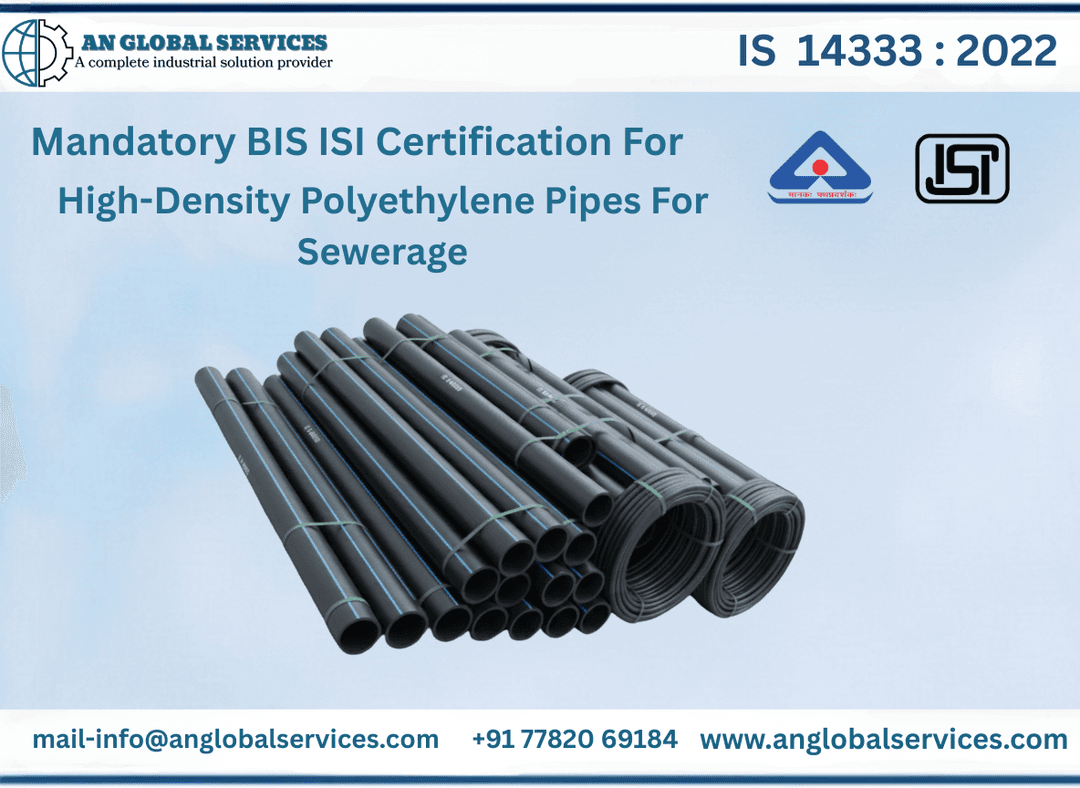
BIS ISI Certification for HDPE Pipes for Sewerage – IS 14333
BIS ISI certification is mandatory for High Density Polyethylene (HDPE) Pipes used in sewerage and drainage systems as per Indian Standard IS 14333:2022. This standard ensures that HDPE pipes meet essential strength, durability, and performance requirements necessary for long-term underground sewerage applications.
HDPE pipes used in sewer networks are continuously exposed to wastewater, soil pressure, external loads, and aggressive environmental conditions. IS 14333 specifies requirements related to material quality, dimensional accuracy, mechanical strength, hydraulic characteristics, and resistance to chemical and environmental stress.
BIS ISI Mark certification under IS 14333 confirms that HDPE pipes have undergone rigorous testing and factory inspection. Certified products are authorized to carry the ISI Mark, ensuring compliance with Indian regulatory standards and suitability for safe, leak-proof sewerage management.
IS 14333:2022 – Key Quality & Performance Requirements for HDPE Pipes
- (i) Use of high-quality High Density Polyethylene compound suitable for sewerage applications
- (ii) Compliance with dimensional tolerances and wall thickness specifications
- (iii) Adequate ring stiffness and structural strength to withstand soil and traffic loads
- (iv) Resistance to chemical attack and environmental stress cracking
- (v) Hydrostatic and leak-tightness performance requirements
- (vi) Durability under long-term underground installation conditions
- (vii) Proper marking including manufacturer details, size, class, and ISI Mark
- (viii) Batch traceability and compliance with Scheme of Inspection and Testing (SIT)
Overview of ISI Mark Certification for HDPE Pipes for Sewerage (IS 14333)
IS 14333:2022 covers High Density Polyethylene (HDPE) pipes intended for underground sewerage and drainage systems. These pipes are designed to provide long service life while maintaining structural integrity under external loads and harsh wastewater conditions.
The standard specifies requirements related to material properties, mechanical strength, hydraulic performance, dimensional accuracy, and marking to ensure reliable and safe sewerage infrastructure.
BIS grants ISI Mark certification only after successful factory inspection, product sample testing in BIS-recognized laboratories, and verification of quality control systems. Certified HDPE pipes are permitted to bear the ISI Mark, confirming conformity with Indian Standards and environmental safety norms.
Process Required for BIS ISI Mark Certification for HDPE Pipes for Sewerage (IS 14333)
To obtain the BIS ISI Mark for High Density Polyethylene (HDPE) Pipes for Sewerage under Indian Standard IS 14333:2022, manufacturers must comply with the BIS Product Certification Scheme (Scheme-I). This certification ensures that HDPE pipes meet prescribed requirements for strength, durability, leak-tightness, and long-term performance in underground sewerage and drainage systems.
Estimated Timeline: The BIS ISI certification process for HDPE pipes for sewerage generally takes around 30–45 days for Indian manufacturers and up to 5–6 months for foreign manufacturers, depending on factory preparedness, inspection scheduling, and laboratory testing.
Step-by-Step Certification Process
- Application Submission: Submit the BIS application through the Manak Online portal with details of HDPE pipes, applicable Indian Standard (IS 14333), factory address, manufacturing process, machinery, and product range.
- Testing & Quality Readiness: Ensure availability of testing facilities for ring stiffness, impact resistance, dimensional accuracy, leak-tightness, and material conformity as specified under IS 14333.
- Factory Inspection: BIS officials conduct an on-site inspection to verify raw material control, extrusion process, quality control systems, marking practices, and compliance with the approved Scheme of Inspection and Testing (SIT).
- Sample Drawing and Testing: HDPE pipe samples are drawn during inspection and tested in BIS-recognized laboratories as per IS 14333:2022 requirements.
- Grant of BIS License: Upon satisfactory inspection and successful test results, BIS grants the Certification Marks License (CM/L), authorizing the manufacturer to use the ISI Mark on HDPE pipes for sewerage.
Requirements to Obtain BIS License for HDPE Pipes for Sewerage (IS 14333)
- HDPE pipes must comply with material, dimensional, mechanical, and performance requirements specified under IS 14333:2022.
- Use of High Density Polyethylene compound suitable for sewerage and drainage applications with resistance to chemical attack.
- Availability of testing facilities for ring stiffness, impact resistance, leak-tightness, and dimensional verification.
- Appointment of qualified quality control personnel to ensure consistent production quality and compliance with BIS norms.
- Strict adherence to the Scheme of Inspection and Testing (SIT) and BIS ISI certification guidelines for HDPE sewerage pipes.
To obtain BIS ISI certification for HDPE Pipes for Sewerage under Product Certification Scheme-I, manufacturers are required to submit documents broadly classified into the following categories:
- Administrative Documents: Company incorporation certificate, factory address proof, GST registration, and statutory approvals.
- Technical Documents: Pipe specifications, sizes, ring stiffness class, extrusion process details, material grade, and compliance declaration as per IS 14333.
- Quality Control Documents: In-house testing capability, calibration records, inspection procedures, and QC personnel details.
- Commercial Documents: Brand name, trademark registration (if applicable), and authorization letters.
Cost of BIS ISI Certification for HDPE Pipes for Sewerage (IS 14333)
The following are indicative statutory charges involved in obtaining BIS ISI Mark certification for HDPE Pipes for Sewerage under Product Certification Scheme-I. All government fees are payable directly to the Bureau of Indian Standards (BIS).
| S. No. | Particular | Amount (INR) | Remarks |
|---|---|---|---|
| 1 | Application Fee | ₹1,000 | Payable to BIS |
| 2 | Inspection / Audit Fee | ₹7,000 | Payable to BIS |
| 3 | Product Testing Fee | As applicable | Depends on pipe size & laboratory |
| 4 | Marking Fee | As per BIS norms | Based on annual production |
Note: Product testing under IS 14333 is a critical stage of the BIS ISI certification process. Costs may vary depending on pipe size, ring stiffness class, and testing scope.
Benefits of Getting ISI Mark Certification for HDPE Pipes for Sewerage (IS 14333)
Obtaining the ISI Mark for High Density Polyethylene (HDPE) Pipes for Sewerage under Indian Standard IS 14333:2022 provides strong regulatory, technical, and commercial advantages. ISI certification confirms that HDPE pipes meet national requirements for strength, durability, leak-tightness, and long-term performance in underground sewerage and drainage systems.
1. Mandatory Regulatory Compliance
HDPE pipes used for sewerage and drainage applications are regulated products in India. ISI Mark certification under IS 14333 is mandatory for lawful manufacturing, sale, supply, or import.
2. Acceptance in Municipal & Infrastructure Projects
ISI-certified HDPE sewerage pipes are widely accepted by municipal corporations, urban local bodies, public utilities, and infrastructure authorities for sewerage and drainage networks.
3. Leak-Proof & Corrosion-Resistant Performance
Certified HDPE pipes offer excellent resistance to chemical attack, corrosion, and environmental stress, ensuring leak-free performance and long service life in aggressive sewerage environments.
4. Enhanced Trust & Brand Credibility
The ISI Mark demonstrates compliance with Indian Standards, building confidence among engineers, consultants, contractors, and project authorities.
5. Competitive Advantage in Government Tenders
ISI-certified HDPE pipes gain preference in government tenders, sewerage infrastructure projects, and EPC contracts, helping manufacturers access regulated and high-value markets.
Frequently Asked Questions (FAQs) – BIS ISI Certification for HDPE Pipes for Sewerage (IS 14333)
1. Is BIS ISI certification mandatory for HDPE pipes used for sewerage?
Yes. HDPE pipes intended for sewerage and drainage applications must comply with IS 14333:2022 and carry a valid ISI Mark before being manufactured, supplied, or imported in India.
2. Which Indian Standard governs HDPE pipes for sewerage?
HDPE pipes for sewerage systems are governed by Indian Standard IS 14333:2022.
3. What are the typical applications of IS 14333 HDPE pipes?
IS 14333 HDPE pipes are used in underground sewerage systems, municipal drainage networks, industrial effluent pipelines, and wastewater management projects.
5. What tests are conducted on HDPE sewerage pipes under IS 14333?
Testing includes ring stiffness, impact resistance, leak-tightness, dimensional checks, material conformity, and visual inspection as prescribed under IS 14333:2022.
6. What are the consequences of supplying non-ISI certified HDPE pipes?
Supplying non-ISI certified HDPE pipes for regulated sewerage applications may result in penalties, rejection in government projects, product seizure, and legal action under the Bureau of Indian Standards Act, 2016.

