UPCOMING QCO ON TEXTILE GOODS BY MINISTRY OF TEXTILE


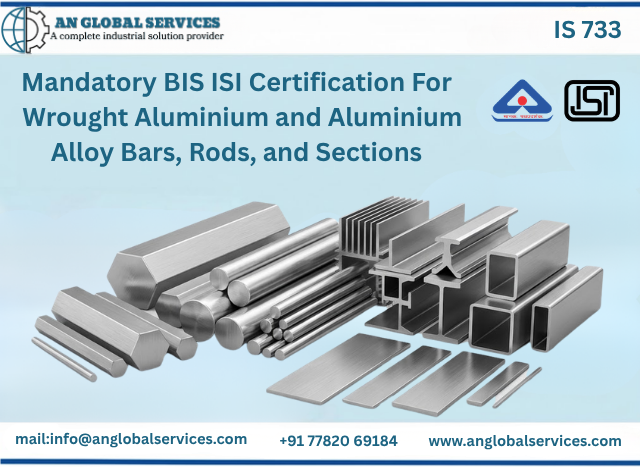
BIS ISI Certification for Wrought Aluminium and Aluminium Alloy Bars, Rods and Sections for general engineering applications IS 733:1983
Wrought aluminium and aluminium alloy bars, rods, and sections are widely used in general engineering applications due to their excellent strength-to-weight ratio, corrosion resistance, and formability. These products are manufactured through processes such as extrusion, rolling, or drawing, making them suitable for structural, fabrication, and industrial applications.
Indian Standard IS 733:1983 specifies the requirements for wrought aluminium and aluminium alloy bars, rods, and sections used for general engineering purposes. The standard covers material composition, dimensions, tolerances, mechanical properties, and quality requirements to ensure reliable performance in various industrial applications.
BIS ISI certification under IS 733:1983 is mandatory for these products, Manufacturers must obtain a BIS license to use the ISI mark before manufacturing, importing, or selling them in the Indian market. This certification ensures that the products meet prescribed quality, safety, and performance standards.
IS 733:1983 – Key Technical Requirements for Wrought Aluminium Bars, Rods and Sections
- (i) Chemical composition requirements of aluminium alloys
- (ii) Mechanical properties including tensile strength
- (iii) Dimensional accuracy, tolerances, and sectional limits
- (iv) Freedom from surface and internal defects
- (v) Peripheral coarse grain structure requirements
- (vi) Manufacturing processes such as extrusion, rolling, or drawing
- (vii) Marking, identification, and traceability requirements
- (viii) Inspection and testing procedures as per the standard
Overview of ISI Mark Certification for Wrought Aluminium and Aluminium Alloy Products
IS 733:1983 applies to wrought aluminium and aluminium alloy bars, rods, and sections intended for general engineering purposes. These products are used in construction, transportation, machinery, and various fabrication applications where strength and corrosion resistance are essential.
The standard ensures that the materials meet specified chemical, mechanical, and dimensional requirements. It also defines acceptable manufacturing practices and quality control measures to maintain consistency and reliability of the products.
BIS ISI certification under the Product Certification Scheme (Scheme I) confirms compliance with IS 733:1983. Manufacturers must establish proper manufacturing facilities, testing capabilities, and quality assurance systems before obtaining the license to use the ISI mark.
Process Required for BIS ISI Mark Certification for Wrought Aluminium Bars, Rods and Sections (IS 733:1983)
To obtain BIS ISI Mark Certification under IS 733:1983, manufacturers must follow the BIS Product Certification Scheme (Scheme I). The process ensures that the products comply with the specified requirements before being introduced into the Indian market.
Estimated Timeline: The BIS ISI certification process generally takes around 30 to 45 days depending on factory inspection scheduling and testing timelines.
Step-by-Step Certification Process
- Application Submission: The manufacturer submits the application through the BIS Manak Online portal with product details, applicable standard (IS 733:1983), and manufacturing information.
- Product Testing Preparation: The manufacturer must ensure testing arrangements for chemical composition, dimensional accuracy, and mechanical properties.
- Factory Inspection: BIS officials inspect the manufacturing unit to verify production processes, quality control systems, and testing facilities.
- Sample Testing: Samples are collected and tested in BIS-recognized laboratories as per IS 733:1983 requirements.
- Grant of BIS License: After successful evaluation, BIS grants the Certification Marks License (CM/L), allowing the use of the ISI mark on the product.
Requirements to Obtain BIS License for Wrought Aluminium and Aluminium Alloy Bars, Rods and Sections (IS 733:1983)
- Compliance of aluminium bars, rods, and sections with chemical composition, mechanical properties, and dimensional requirements as specified under IS 733:1983.
- Availability of testing facilities for chemical analysis, tensile testing, dimensional verification, and inspection of surface defects.
- Appointment of qualified quality control personnel responsible for monitoring production processes and ensuring compliance with BIS standards.
- Implementation of the Scheme of Inspection and Testing (SIT) prescribed by BIS for consistent product quality and conformity.
To obtain BIS ISI Mark Certification for wrought aluminium and aluminium alloy bars, rods, and sections under Product Certification Scheme-I, manufacturers must submit documents categorized as follows:
- Administrative Details: Business registration documents, factory address proof, GST registration, and other statutory approvals.
- Technical Details: Product specifications, alloy grades, sectional dimensions, manufacturing processes (extrusion/rolling/drawing), and testing parameters as per IS 733:1983.
- Quality Control Personnel Details: Qualification and experience of personnel responsible for testing and inspection.
- Commercial Details: Brand name, trademark details (if applicable), and authorization documents.
Cost of BIS ISI Certification for Wrought Aluminium and Aluminium Alloy Bars, Rods and Sections (IS 733:1983)
The following are indicative government charges involved in obtaining BIS ISI Certification under Product Certification Scheme-I. These fees are payable to BIS.
| S. No. | Particular | Amount (INR) | Remarks |
|---|---|---|---|
| 1 | Application Fee | ₹1,000 | Payable to BIS |
| 2 | Inspection / Audit Fee | ₹7,000 | Payable to BIS |
| 3 | Product Testing Fee | As applicable | Depends on product type and laboratory testing |
| 4 | Marking Fee | As per actual | As per BIS fee structure |
Important Note: Product testing as per IS 733:1983 is mandatory before grant of license. BIS evaluates manufacturing capability, testing facilities, and quality control systems during certification.
Benefits of Getting ISI Mark Certification for Wrought Aluminium Products (IS 733:1983)
ISI certification for aluminium bars, rods, and sections ensures compliance with Indian standards and provides multiple advantages to manufacturers and users.
1. Assured Product Quality
Certification ensures compliance with chemical composition, mechanical properties, and dimensional accuracy as per IS 733:1983.
2. Mandatory Market Compliance
BIS ISI certification is mandatory, and products may require certification if covered under mandatory BIS regulations.
3. Improved Market Acceptance
ISI-marked aluminium products are widely accepted across engineering, construction, and industrial sectors.
4. Enhanced Brand Credibility
The ISI mark builds trust among customers, contractors, and regulatory bodies.
5. Competitive Advantage
Certified manufacturers gain preference in government tenders and industrial projects.
Frequently Asked Questions (FAQs) – BIS ISI Certification for Aluminium Bars, Rods and Sections (IS 733:1983)
1. Which standard applies to aluminium bars, rods, and sections?
These products are covered under Indian Standard IS 733:1983.
2. Are aluminium bars and rods BIS ISI certification mandatory?
Yes, BIS ISI certification is mandatory for products covered under IS 733:1983.
3. What is the validity of BIS ISI license?
The BIS license is generally valid for one year and can be renewed.
4. What tests are conducted under IS 733?
Tests include chemical composition, tensile strength, dimensional checks, and inspection for surface defects.
5. How long does certification take?
The certification process generally takes 30 to 45 days.