UPCOMING QCO ON TEXTILE GOODS BY MINISTRY OF TEXTILE


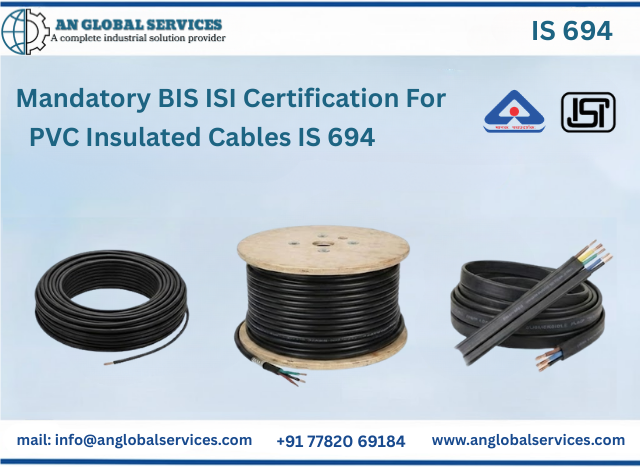
BIS ISI Certification for PVC Insulated Cables IS 694
Indian Standard IS 694:2010 specifies the requirements for PVC insulated cables used for working voltages up to and including 1100 volts. These cables are widely used in electrical installations for power distribution, lighting systems, and general wiring applications across residential, commercial, and industrial environments.
The standard covers single-core and multicore cables and cords with rigid or flexible conductors made from annealed bare or tinned copper or aluminium. These conductors are insulated and sheathed using polyvinyl chloride (PVC), which provides durability, insulation protection, and resistance against heat, chemicals, and moisture.
BIS ISI certification under IS 694:2010 ensures that PVC insulated cables meet the prescribed safety, performance, and quality requirements. Manufacturers must obtain a BIS license to use the ISI mark on their cables before selling or distributing them in the Indian market.
IS 694:2010 – Key Technical Requirements for PVC Insulated Cables
- (i) Conductors made of annealed copper or aluminium as per IS 8130
- (ii) PVC insulation suitable for rated voltage up to 1100 V
- (iii) Single core and multicore cable construction requirements
- (iv) Conductor temperature limits up to 70°C or 85°C
- (v) FR and FR-LSH fire performance cable categories
- (vi) Electrical resistance and insulation performance requirements
- (vii) Suitability for indoor and outdoor installation environments
- (viii) Marking, labeling, and packaging requirements
Overview of ISI Mark Certification for PVC Insulated Cables
IS 694:2010 applies to PVC insulated cables designed for working voltages up to and including 1100 volts. These cables are commonly used in electric power distribution, building wiring, and lighting circuits.
The standard includes different cable categories such as cables for indoor installations, outdoor installations, flame retardant (FR) cables, and flame retardant low smoke and halogen (FR-LSH) cables. Each category must meet specific safety, insulation, and fire-performance requirements to ensure safe operation in various installation environments.
BIS ISI certification under the Product Certification Scheme (Scheme I) confirms that the cables comply with Indian safety and quality standards. Manufacturers must demonstrate adequate production facilities, testing capabilities, and quality control systems before BIS grants the license to use the ISI mark.
Process Required for BIS ISI Certification for PVC Insulated Cables (IS 694:2010)
To obtain BIS ISI certification for PVC insulated cables under IS 694:2010, manufacturers must follow the BIS Product Certification Scheme (Scheme I). This process ensures that the cables comply with Indian safety standards, electrical performance requirements, and construction specifications before they are marketed in India.
Estimated Timeline: The BIS ISI certification process for PVC insulated cables typically takes around 30 to 45 daysdepending on product testing timelines, factory inspection scheduling, and completeness of documentation.
Step-by-Step Certification Process
- Application Submission: The manufacturer submits the BIS application through the Manak Online portal with product details, applicable standard (IS 694:2010), factory address, manufacturing process, and machinery information.
- Product Testing Preparation: The manufacturer must ensure proper testing arrangements as required under IS 694:2010. Testing verifies electrical performance, conductor resistance, insulation quality, and safety parameters.
- Factory Inspection:BIS officers conduct a factory inspection of the manufacturing unit to evaluate production facilities, quality control systems, and testing infrastructure.
- Sample Testing: Cable samples are drawn during the inspection and sent to BIS recognized laboratories for testing according to IS 694:2010 specifications.
- Grant of BIS License: If the factory inspection and test results meet the required standards, BIS grants the Certification Marks License (CM/L), allowing the manufacturer to affix the ISI mark on PVC insulated cables.
Requirements to Obtain BIS License for PVC Insulated Cables (IS 694:2010)
- Compliance of PVC insulated cables with all technical requirements specified under Indian Standard IS 694:2010.
- Availability of proper testing facilities for conductor resistance, insulation performance, and electrical safety tests as per BIS requirements.
- Appointment of qualified quality control personnel responsible for monitoring manufacturing quality and compliance with standards.
- Implementation of the Scheme of Inspection and Testing (SIT) as prescribed by BIS for PVC insulated cables.
To obtain BIS ISI certification for PVC insulated cables under Product Certification Scheme-I, manufacturers must submit documents that are generally categorized into the following groups:
- Administrative Details: Business registration documents, factory address proof, GST registration, and other statutory approvals.
- Technical Details: Cable design specifications, conductor type, insulation material details, rated voltage, and product testing parameters as per IS 694:2010.
- Quality Control Personnel Details: Qualification, experience, and responsibilities of staff responsible for product testing and quality monitoring.
- Commercial Details: Brand name, trademark details (if applicable), and authorization documents related to the product.
Cost of BIS ISI Certification for PVC Insulated Cables (IS 694:2010)
The following are indicative government and related charges involved in obtaining BIS ISI certification for PVC insulated cables under Product Certification Scheme-I. These statutory charges are payable directly to the Bureau of Indian Standards (BIS).
| S. No. | Particular | Amount (INR) | Remarks |
|---|---|---|---|
| 1 | Application Fee | ₹1,000 | Payable to BIS |
| 2 | Inspection / Audit Fee | ₹7,000 | Payable to BIS |
| 3 | Product Testing Fee | As applicable | Depends on cable type and laboratory |
| 4 | Marking Fee | As per actual | Based on BIS fee structure |
Important Note: Product testing as per IS 694:2010 is a crucial step in the BIS ISI certification process. BIS may evaluate the manufacturing facility and testing capabilities before granting the license. The above charges are indicative and may vary depending on inspection scope and testing requirements.
Benefits of Getting ISI Mark Certification for PVC Insulated Cables (IS 694:2010)
Obtaining ISI certification for PVC insulated cables under IS 694:2010 offers several regulatory and commercial benefits. The ISI mark confirms that cables meet Indian requirements related to electrical safety, insulation performance, and construction quality, ensuring that the product is suitable for use in electrical installations across India.
1. Compliance with Indian Quality Standards
ISI certification ensures that PVC insulated cables comply with Indian Standard IS 694:2010 and meet prescribed electrical safety and performance requirements.
2. Improved Market Acceptance
ISI-certified cables are widely accepted by distributors, electrical contractors, and institutional buyers, improving market access across residential and commercial sectors.
3. Assured Electrical Safety
Certified cables undergo strict testing for insulation resistance, conductor resistance, and fire performance to ensure safe electrical operation.
4. Increased Brand Credibility
The ISI mark improves product credibility and assures customers that the cable meets recognized Indian quality standards.
5. Competitive Advantage
ISI certification helps manufacturers compete effectively in the electrical cable market by demonstrating compliance with safety and performance standards.
Frequently Asked Questions (FAQs) – BIS ISI Certification for PVC Insulated Cables (IS 694:2010)
1. Which standard applies to PVC insulated cables in India?
PVC insulated cables used for working voltages up to and including 1100V are covered under Indian Standard IS 694:2010.
2. What types of conductors are covered under IS 694?
The standard covers cables with copper or aluminium conductors that comply with IS 8130 requirements.
3. What is the validity of a BIS ISI license?
The BIS license is generally granted for one year initially and can be renewed subject to continued compliance with BIS requirements.
4. How long does the certification process take?
The BIS ISI certification process usually takes around 30 to 45 days depending on inspection scheduling and product testing timelines.
5. What tests are conducted for PVC insulated cables?
Tests include conductor resistance test, insulation resistance test, high voltage test, heat shock test, and other performance tests specified under IS 694:2010.