UPCOMING QCO ON TEXTILE GOODS BY MINISTRY OF TEXTILE


BIS ISI Certification For Furniture & Plywood Products
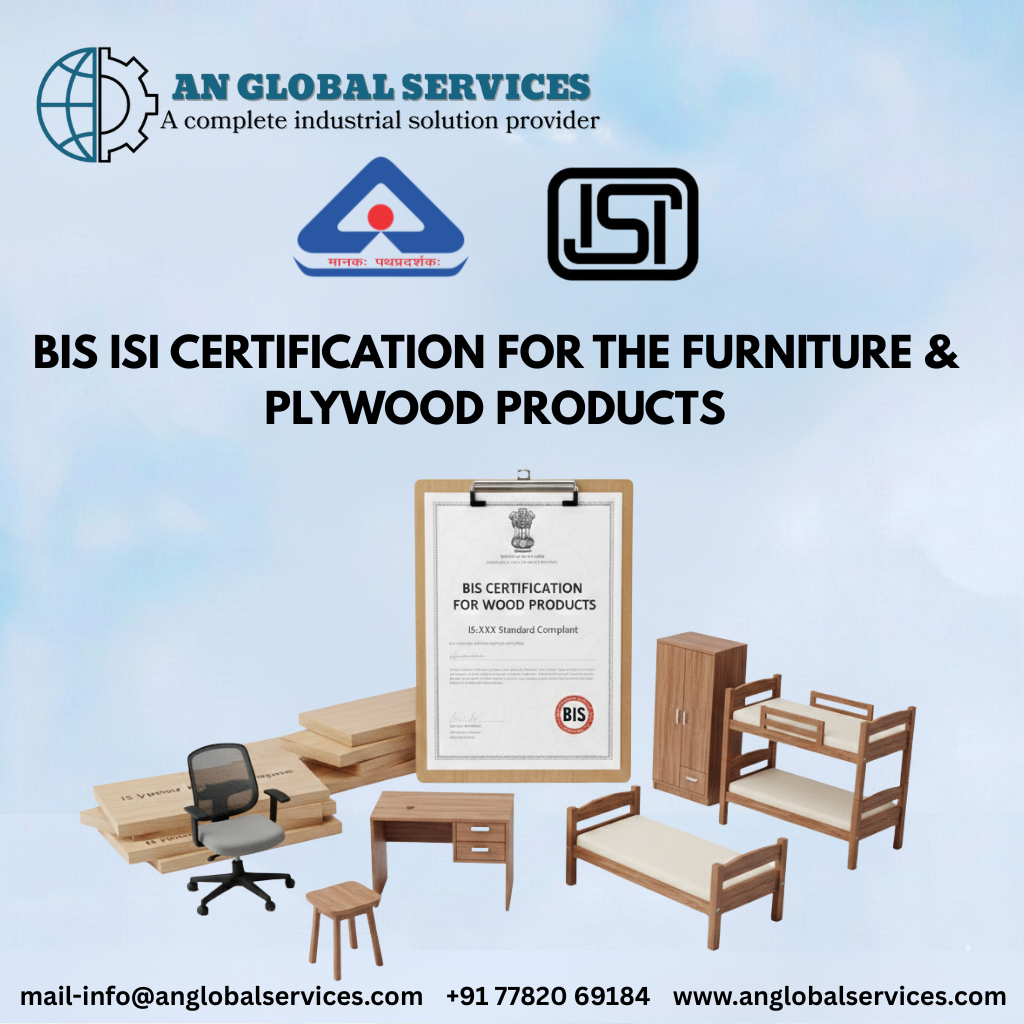
BIS ISI MARK CERTIFICATION FOR FURNITURE & PLYWOOD PRODUCTS
BIS ISI Mark certification is now a mandatory requirement for selected furniture and plywood products sold or imported in India. Under the Furniture (Quality Control) Order, 2025, issued by the Bureau of Indian Standards (BIS), manufacturers and importers must ensure that their products comply with the prescribed Indian Standards and carry the ISI Mark before being offered in the Indian market.
BIS ISI Mark certification for furniture focuses on ensuring product safety, strength, durability, stability, and overall performance during regular use. The certification applies to both Indian manufacturers and foreign manufacturers supplying furniture to India, helping eliminate substandard products and improve consumer safety.
The following furniture products require mandatory BIS ISI Mark certification as per the applicable Indian Standards:
- Work Chairs (Office / Task Chairs) – IS 17631:2022
- General Purpose Chairs and Stools – IS 17632:2022
- Tables and Desks – IS 17633:2022
- Storage Furniture such as Wardrobes and Cabinets – IS 17634:2022
- Beds – IS 17635:2022
- Bunk Beds – IS 17636:2022
Along with furniture, BIS ISI Mark certification is also compulsory for plywood products sold or imported in India. As per the Quality Control Order issued in 2024, plywood manufacturers and importers must obtain BIS ISI certification to legally sell plywood in the Indian market. Non-certified plywood products are not permitted for sale or distribution.
BIS ISI Mark certification for plywood ensures proper bonding strength, resistance to moisture, dimensional stability, and long-term performance. Certified plywood products meet defined quality and safety benchmarks, making them suitable for use in furniture manufacturing and construction applications.
BIS ISI Mark certification for plywood is required under the following Indian Standards:
- IS 303 – Plywood for General Purposes
- IS 710 – Marine Grade Plywood for High Moisture Conditions
BIS ISI Mark certification for plywood helps businesses meet mandatory legal requirements, improve product reliability, and build customer trust. Certified plywood is widely preferred in government projects, institutional procurement, and organized retail markets due to assured quality and compliance.
How to Get BIS ISI Mark Certification for Furniture
BIS ISI Mark certification for furniture follows a defined approval process to ensure products meet Indian safety, strength, and durability standards. Since the Furniture (Quality Control) Order, 2025 is now in force, manufacturers and importers must complete the following steps to legally sell furniture products in India.
| Step | Stage | Description |
|---|---|---|
| 1 | Identify Product Standard | Select the applicable Indian Standard (IS) for your furniture product such as work chairs, tables, storage units, beds, or bunk beds. Each product category has a specific IS code prescribed by BIS. |
| 2 | Documentation & Preparation | Prepare business documents such as GST, MSME/Udyam registration, and factory license. Also arrange manufacturing details, raw material information, machinery list, basic in-house testing facilities, and factory layout plan. |
| 3 | Online Application | Apply online through the BIS Manak Online portal by registering your firm, filling Form-V, uploading required documents, and paying the application fee. |
| 4 | Factory Inspection & Testing | A BIS officer visits the manufacturing unit to verify production processes and testing facilities. Product samples are sealed and sent to a BIS-recognized laboratory for strength, stability, and durability testing. |
| 5 | Grant of License | If the factory inspection and test results are satisfactory, BIS issues the CM/L number. The manufacturer is then authorized to use the ISI Mark on approved furniture products. |
Important: BIS ISI Mark certification is mandatory under the Furniture QCO. Selling or importing non-certified furniture may result in penalties, product seizure, or market restrictions.
Documents Required for BIS ISI Mark Certification for Furniture
To obtain the BIS ISI Mark for furniture products in 2026, manufacturers must submit a complete set of documents through the BIS Manak Online portal. These documents help BIS verify the legal status of the business, manufacturing capability, quality control systems, and product details.
1. Administrative & Legal Documents
- Business registration documents such as Certificate of Incorporation, Partnership Deed, or MSME / Udyam Registration.
- Address proof of the manufacturing unit such as Factory License, GST Certificate, or Trade License showing the factory location.
- Identity proof of the Authorized Signatory such as Aadhaar Card, Voter ID, or Passport.
- Location map of the factory, including a simple sketch or Google Maps screenshot showing nearby landmarks.
2. Technical & Manufacturing Documents
- Manufacturing process flowchart showing each step from raw material entry to final packing.
- List of machinery used in production such as cutting machines, welding sets, edge banders, along with capacity and serial numbers.
- Plant layout drawing indicating production areas, storage sections, and the in-house testing laboratory.
- Raw material details including wood, steel, fabric, foam, or boards, along with their quality or material test certificates.
3. Quality Control (QC) Documents
- List of in-house testing equipment such as load testers, stability rigs, impact testers, and durability testing machines.
- Valid calibration certificates of testing equipment issued by NABL-accredited laboratories.
- Details of quality control staff including names, roles, and basic qualifications.
- Scheme of Inspection and Testing (SIT) duly signed and accepted by the manufacturer as per BIS requirements.
4. Product-Specific Information
- Detailed product drawings with dimensions and specifications for each furniture model to be certified.
- Brand or trademark details, if the products are sold under a registered brand name.
- BIS-recognized laboratory test reports, if any pre-testing has been conducted before application.
Estimated Fees Required for BIS ISI Mark Certification of Furniture Products
BIS ISI Mark certification involves certain government fees payable to the Bureau of Indian Standards (BIS) and BIS-recognized laboratories. The actual cost may vary based on product type, number of models, and testing requirements. Below is an indicative breakup of the standard government charges.
| Fee Component | Estimated Amount |
|---|---|
| Application Fee | ₹1,000 |
| Audit / Inspection Fee | ₹7,000 |
| Laboratory Testing Fee | Depends on the product and Testing |
| Marking Fee | Depends on the specific IS Standard |
Note: The above fees are indicative government charges only. Actual costs may vary based on the number of product variants, testing scope, factory location, and applicable Indian Standards. Professional consultancy fees are separate.
FURNITURE AND PLYWOOD PRODUCTS UNDER BIS ISI CERTIFICATION SERVICE
| Product | Standard | Product | Standard |
|---|---|---|---|
| Work Chairs | IS 17631: 2022 | General Purpose Chairs & Stool | IS 17632: 2022 |
| Furniture Tables and Desks | IS 17633:2022 | Furniture – Storage Units | IS 17634:2022 |
| Furniture - Beds | IS 17635: 2022 | Furniture - Bunk Beds | IS 17636: 2022 |
| Plywood for General Purposes | IS 303: 1989 | Marine Plywood | IS 710: 2010 |
IS 17631: 2022
IS 17632: 2022
IS 17633:2022
IS 17634:2022
IS 17635: 2022
IS 17636: 2022
IS 303: 1989
IS 710: 2010
Testing Equipment Required for BIS ISI Mark Certification of Furniture
To obtain the BIS ISI Mark for furniture products, manufacturers must set up a basic in-house testing facility at their factory. As per the Furniture (Quality Control) Order in force from 2025–2026, BIS verifies that manufacturers have the required testing equipment to ensure product strength, stability, and durability during regular production.
Mandatory In-House Testing Equipment
- Dimensional Measuring Tools: Vernier calipers, micrometers, and measuring tapes for checking size, height, width, and thickness of furniture parts.
- Static Load Testing Equipment: Used to apply heavy weight on chairs, tables, or beds to check structural strength and load-bearing capacity.
- Stability Testing Setup: Inclined platforms or pull force gauges to ensure furniture does not tip over during use.
- Impact Testing Equipment: Drop hammer or vertical impactor to simulate sudden sitting, dropping of objects, or impact on furniture surfaces.
- Durability Cycle Tester: A motorized or pneumatic system that repeatedly applies force to simulate long-term usage of chairs, tables, or beds.
- Surface Performance Test Kit: Tools to check scratch resistance, surface finish, and resistance to liquids or chemicals for laminated or polished furniture.
| Test Type | Purpose | Equipment Used |
|---|---|---|
| Stability Test | Ensures furniture does not tip or fall during use. | Inclined plane, force gauge, weights |
| Static Load Test | Checks strength under heavy load. | Load frame, calibrated weights |
| Durability Test | Simulates long-term use and wear. | Cyclic load testing machine |
| Impact / Drop Test | Tests resistance to sudden impact. | Drop hammer or impactor |
Compliance Checklist for 2026
- All testing equipment must have valid calibration certificates from NABL-accredited laboratories (not older than 1 year).
- Standard Operating Procedures (SOPs) should be clearly displayed near each testing machine.
- Small and Medium Enterprises may receive limited transition time to complete the testing setup as per BIS guidelines.
- Test certificates for raw materials such as wood, metal, fabric, or boards should be available for verification during BIS inspection.
Benefits of BIS ISI Mark Certification for Furniture
BIS ISI Mark certification for furniture is now a mandatory legal requirement under the Furniture (Quality Control) Order, 2025, effective from February 2026. Apart from meeting regulatory rules, the certification offers several practical and long-term business benefits for furniture manufacturers and importers.
1. Access to Government Tenders & Institutional Sales
Government departments, public sector units, and large institutions prefer or require ISI-marked furniture for procurement. BIS ISI certification allows manufacturers to participate in high-volume government tenders and institutional supply contracts without restrictions.
2. Improved Brand Trust and Market Credibility
The ISI Mark acts as a visible sign of quality and safety. It assures customers that furniture products are strong, stable, and safe for daily use. Retailers and online marketplaces also prefer certified products, increasing brand acceptance and customer confidence.
3. Better Quality Control and Production Efficiency
BIS ISI certification encourages manufacturers to follow standard production practices and regular in-house testing. This results in consistent product quality, reduced defects, fewer customer complaints, and lower rejection or return rates.
4. Smooth Import Clearance and Market Protection
For importers, BIS ISI Mark certification helps avoid shipment delays, penalties, or seizure at Indian ports. For domestic manufacturers, mandatory certification ensures fair competition by restricting the entry of low-quality and non-compliant furniture into the Indian market.
5. Readiness for International Markets
Indian Standards for furniture are aligned with global quality benchmarks. BIS ISI Mark certification helps manufacturers prepare for export audits and quality checks, making it easier to expand into international markets.
How to Get BIS ISI Mark Certification for Plywood (IS 303)
BIS ISI Mark certification for plywood is mandatory in India under the BIS Product Certification Scheme. Plywood manufacturers must comply with Indian Standard IS 303 to legally manufacture and sell general-purpose plywood in the Indian market.
| Step | Description |
|---|---|
| 1 | Ensure compliance with IS 303 by identifying the plywood grade (MR or BWP) and confirming that your factory has a complete manufacturing setup such as peeling, drying, gluing, and pressing. |
| 2 | Set up an in-house testing laboratory with required equipment for moisture, bonding strength, water resistance, and dimensional checks. |
| 3 | Apply online through the BIS Manak Online portal by submitting Form-V along with business documents, factory layout, machinery list, and calibration certificates. |
| 4 | BIS conducts a factory inspection to verify production processes, quality control staff, and in-house testing facilities. Product samples are sealed for independent lab testing. |
| 5 | If the factory audit and test reports meet IS 303 requirements, BIS grants the CM/L number and allows the use of the ISI Mark on plywood sheets. |
Timeline: Usually 1–3 months depending on inspection scheduling and laboratory test results.
Testing Equipment Required for BIS ISI Mark Certification of Plywood
BIS requires plywood manufacturers to maintain a fully functional in-house laboratory to perform routine testing as per IS 303. These instruments are verified during the BIS factory audit.
1. Dimensional & Visual Testing
- Micrometer / Vernier Calipers
- Steel Scale (1 m / 2 m)
- Measuring Tape
- Try Square
- Straight Edge & Feeler Gauge
2. Moisture & Density Testing
- Hot Air Oven (103 ± 2°C)
- Digital Moisture Meter
- Weighing Balance (0.01 g)
- Desiccator
3. Adhesive & Water Resistance
- Water Bath
- Testing Knife
- pH Meter
- Viscosity Cups
4. Mechanical Strength Testing
- Universal Testing Machine (UTM)
- Bending & Shear Fixtures
- Tension / Compression Jaws
5. Biological & Chemical Testing
- Mycological Tray
- BOD Incubator
- Chemical Glassware
Compliance Note: All testing equipment must have valid NABL calibration certificates. A trained quality control person must maintain test records and logbooks as per BIS requirements.